

Asura: Domestic Lives Behind the Screen

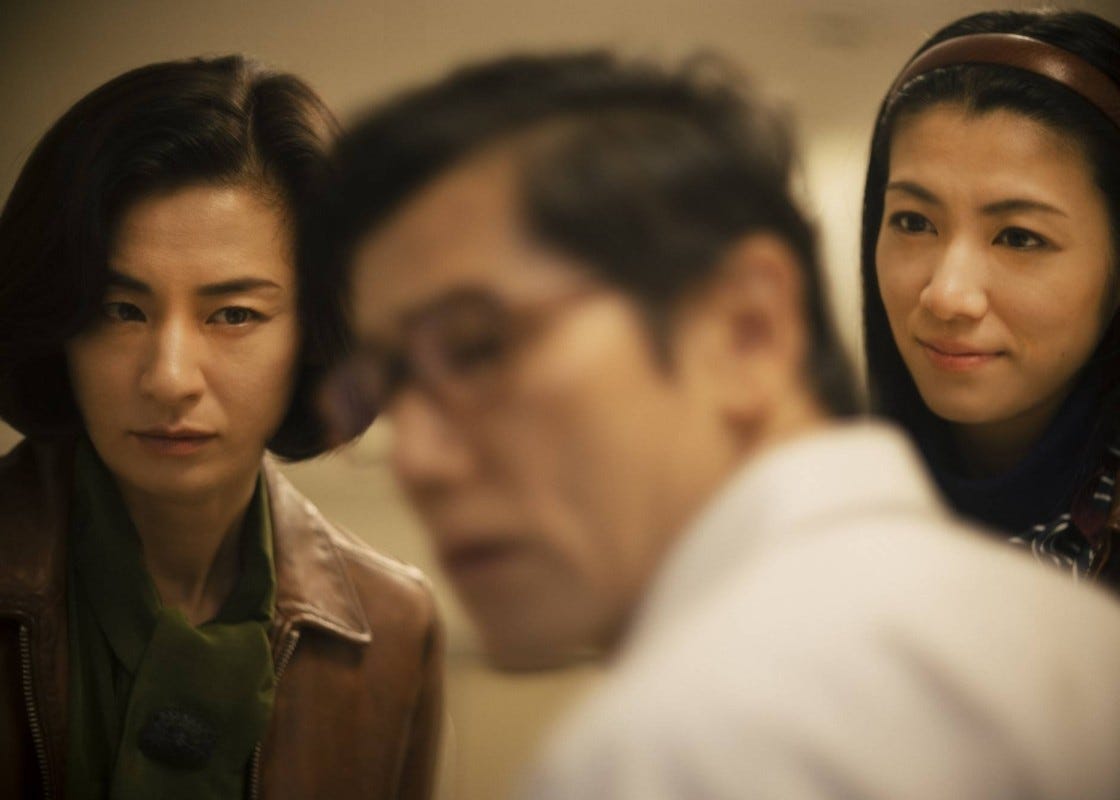
Hirokazu Kore-eda’s Netflix mini-series traces the hidden threads of performance that hold family life together, with everyday items for props.
Behind a delicate screen -- frosted glass, lace curtains, sheets drying in the sun - there’s an outline of a figure. With a quick flick, we glimpse a familiar face, absorbed in their emotions. This visual motif aptly expresses Asura’s central concern: the longings buried behind well-mannered facades, and their uneasy expression within the domestic sphere.
The 2025 adaptation of Kuniko Mukoda’s novel opens with a young woman calling her older sister, who is preoccupied with packing off her family for the day. After batting down the usual distractions -- an enquiry about marriage plans, a child hunting for pocket money -- she secures a promise to meet that evening without revealing her intentions.
This short conversation -- domestic and disarming on the surface, with questions circling around what’s left unsaid -- sets the tone for Asura. In short order, Takiko, the librarian, rings her other two sisters to round out the family gathering. A quartet composed of a widow, a housewife, a librarian, and a waitress, they’re bound by brusque affection that can’t entirely mask the passage of time pulling them apart.
Family scandal -- kicked off by Takiko’s suspicion that their elderly father has been having an affair -- is the catalyst that re-ignites the complicated web of loyalty and rivalry between the sisters. It also exposes their own hidden longings, from a sister with a secret affair of her own to another hitching her fortunes to an aspiring boxer.
What pushes Asura beyond the realm of family melodrama is the unsettling assertiveness of Takiko’s announcement. She’s not so much outraged at her father’s deception as she is by her sisters’ deliberate complacency in the face of loneliness and betrayal in their own lives. Instead of issuing smug reminders to get married, she’s saying, why can’t you stand up for yourselves?
Like Laurie Colwin’s stories -- set in a similar time, different place -- Asura explores the emotional currents flowing through ordinary lives free from mayhem, at least on the surface. The characters gather around savory home-cooked meals and commiserate over tea, carefully taking stock of their emotions like the candied fruits and rum for Colwin’s Jamaican fruitcake.
The crucial difference between the two worlds is in how much self-expression the characters feel entitled to. Colwin’s female protagonists may wonder if they’re being difficult or selfish. But they never truly doubt that self-fulfillment is attainable, out there waiting for them. In Asura’s world, Makiko — the most self-assured sister — doubling down on her suspicions of her husband’s infidelity at the end of the story is a seismic event, bringing Takiko’s opening salvo full circle.
Asura is not the kind of story to spell out what’s at stake. Instead the four sisters’ lives illustrate how emotions are suppressed and expressed, within a contrast of personalities. Nor is there any grand rupture or resolution. Rather, Asura is interested in the quiet flow of emotions, like a moment of joy blooming between Takiko and her beau through the glass wall of a downtown lobby, unnoticed by passersby.
In the final episode, we find the eldest two sisters bathed in winter sunlight after a stretch of darkness, waiting for the bus. We see Makiko’s face from the side, chin up — her signature angle — as she ruminates on her husband’s lack of affection. She looks like a woman finished with hiding her doubts, her face upturned toward the sun.